In October of last year a new ambitious independent arts and culture magazine named ALL—IN saw light, which we unfortunately missed at that time. No doubt because the arrival of new magazines hasn't really slowed down in a period which has "print is dead" written all over its digital face. And despite, one has to say, the fact that the magazine introduced itself to the world with an unusual high profile cover interview with powerhouse actor Willem Dafoe. Founders Benjamin Barron and Allison Littrell, who have met while studying at the prestigious Bard College, take their project very serious. Next to the interview with Dafou, who was shot by Alex Da Corte, contributors to the first issue are names like Benjamin's mother; Jeannette Montgomery Barron, but also John Waters, Bernadette Corporation, Cory Arcangel, and pop superstar Dev Hynes. By now the first issue's 1000 prints and practically sold out and last month Barron and Littrel presented their upcoming 176 pages second issue (which will drop in August) for online pre-order with a party in the Boom Boom Room in New York.
Following Willem Dafoe's playful cover, this time around the magazine has two covers: featuring no less than enfant terrible Harmony Korine and actress and activist Amandla Stenberg — two perfect subjects to represent these times of turmoil in the United States (and far beyond). The noble motive behind this second issue is no less than bringing people together. A message which is never placed in the foreground, but is clearly distillable from the choice of subjects and the stories that are told about them. In his interview Harmony Korine talks with Marfa Journal about selling out, always being the best Harmony, and how to balance success and sensitivity. Actress and activist Amandla Stenberg opens up to her friend Emmanuel Olunkwa about authenticity, celebrity, and owning your identity; Amandla also discusses what it means to be an activist in her exclusive essay, 'Authenticity Activism'. [ Continue reading ]
At the moment we are immersing ourselves in the world of elegant sportswear for an extremely exciting new project we are working on (which we will elaborate on whenever we can in the near future). One of the highly inspirational brands we have encountered along this research is the South Korean brand IISE [translates to second generation], founded by Terrence and Kevin Kim, two second-generation Korean-American brothers who were so inspired by their cultural roots that they decided to create a brand founded on them. Debuting in 2015 with a full collection, given the moniker 001, the brand had been producing naturally-died bags and accessories since 2013. It introduced its 002 collection two months ago, with a lot more to come in the coming months.
The new direction for IISE was received with open arms by the streetwear media ecosystem, gathering both both on- and offline widespread media attention, ensuring a quick worldwide introduction of the brand's new ambitious move into clothing. The designs by Terrence and Kevin marry the Far East with the West and are constructed from a hybrid of both traditional Korean and modern materials, such as the “mu-myung” and “guangmok” fabrics that are naturally-dyed cottons of Korea’s traditional garb. Reinterpreting these iconic textiles into a sportswear inspired vision, the unique cottons are integrated into the garments along with premium materials such as leather, raw silk fleck and nylon twill. Beyond just the interesting fabrics used, the brothers succeed in implementing graphic elements inspired by Korean woodwork throughout the collection and completing their creations with its elegant roomy and cropped cuts. For us IISE makes some of the most inspirational sportswear-inspired clothing available today. [ Continue reading ]
More than two years ago we wrote about a new Jungles in Paris story which took the reader on an insightful trip to the West African country of Senegal. As in most Sub-Saharan African countries football is the clear favorite sport there, but an indigenous sport that has existed for centuries is traditional wrestling named Laamb in Wolof. It is one of the sports in which the young men engage on the famous 'Plage de Fann' beach in Dakar, which was singled out in the beautiful story. Since ancient times Senegalese wrestlers competed before the king and queen in village squares. Singers, dancers, and storytellers embellished the match. Wrestlers wore amulets to ward off evil spirits and black magic from their opponents. Nowadays, the tradition remains strong. As in former times, griots praise the victors in song and dance.
The contemporary champions of the traditional wrestling sports are celebrities in Senegal, with fighters such as Yékini (Yakhya Diop), Tyson (Mohamed Ndao), and Bombardier (Serigne Ousmane Dia) the best known. Today we want to take another look at the beautiful sport, this time through the lens of French photographer Laurent Laporte who shot a series on one of his many travels named after the famous wrestler: 'Bombardier'. Young Senegalese boys, who meet each other on beaches like Plage de Fann, dreaming to become as big as 'the bomber' — caught remarkably by Laporte who made the series half duotone and half color. Finding remarkable frames which represent both the sport and the country in a unique and exciting way. [ Continue reading ]
British artist Joe Cruz has been a favorite of us for the last few years, from the very moment we first encountered his incredible collages somewhere in 2012. In 2013 we found ourselves very lucky to have collaborated with him for Journal de Nîmes Nº 9 and we followed his development with every new step. Over the course of these years in which we had Cruz on our radar, he continued to challenge himself. Finding new territories for his imagery in which he applies his distinct signature style, which can be typified by his incredible use of color, iconic fashion imagery and ethnic influences, combining the different elements into his signature visual language — whether in collages, textile designs, illustrations, the remarkable ongoing collaboration with photographer Jack Davison. Last week he presented his first project placed directly in the public sphere. For the new series Cruz has teamed up with London-based Jack Agency, resulting in the latest addition to their ongoing 'Your Space Or Mine' project. The collaboration sees the agency support Joe Cruz, as he showcases his work at the largest scale till date, directly on the streets across his hometown London, in the Shoreditch area, for the first time. Bringing his familiar signature aesthetic, with its fashion photography influences, to a billboard size proves to be a perfect fit.
We can only hope for more after this whole new scale for Joe's unique vision... [ Continue reading ]
Although in recent years they have become a household name in fashion photography through their ongoing work relationship with it-brand Mansur Gavriel (and strong visability throughout downtown New York City) and work for numerous fashion magazines, we haven't shared the work of Ukrainian twin sisters Tanya and Zhenya Posternak here before. Known for the so called 'Posternak crop' —staying as close to the essence of their subject which often-times results in a rather unusual yet elegant focus— their style can be described best as minimalist, colorful, never failing to be striking and full of charisma, regardless if an actual human being or just an object is in front of the camera. Flicking through the catalogue they have shared over the course of the last few years: ranging from assignments, the captures from their travels on their blog and all the images they have shared on their instagrams — one can only conclude that the Posternaks make it look so effortless to capture the available essence of what characterizes someone or -thing in front of their lens. We know that isn't true and it's simply their unique perspective on the world around us. Almost like an elegant form of camouflage (reminding strongly of Robby Müller's camerawork) the twins create imagery which is unique without losing a sense of universally appealing emotions to be observed in all of their work, both on commissions and free work. We can't get enough of it...
We are deeply moved by human imperfections, whether it be a birthmark or facial hair. With our photography we aim to get closer both to the subject and the viewer. Frankly, we don’t follow any brand’s guidelines other than curiosity for all things beautiful and woolly. [ Continue reading ]
Launched on the 30th of June, but presented to the public today at the Rapha Cycle Club in London, writer Max Leonard and photographer Camille McMillan present an incredible new publication by the name of 'Bunker Research'. Leonard, who is an avid cyclist, found inspiration for the new project while riding around the Alpes-Maritimes region of France, where he noticed the strange structures hidden in the landscape — discrete buildings that seemed to appear out of nowhere in remote locations far away from civilization. The question what and why these military bunkers were doing there, drove the writer —who joined forces with Camille McMillan to document them properly— to find and research these hidden concrete shelters for eight months, which eventually resulted in this elegant printed study.
Strategically placed throughout the French Alps by the French, these bunkers were built in some of the most remote places in Europe. Constructed from reinforced concrete, the constructions blend into their rugged, pristine environment. Although they are slowly succumbing to the elements as they aren't used anymore, the bunkers are enduring features in the landscape and relics from a different time in world politics. The structures with fortifications’ concrete walls were built to withstand bomb blasts, so it will take many more decades for them to totally have disappeared. Until that moment they just lay there, constructed from a form follows function ideology, resulting in a brutalist organic aesthetic, being a unique subgenre in architecture, of which a super interesting chapter is now beautifully captured and presented by Leonard and McMillan. [ Continue reading ]
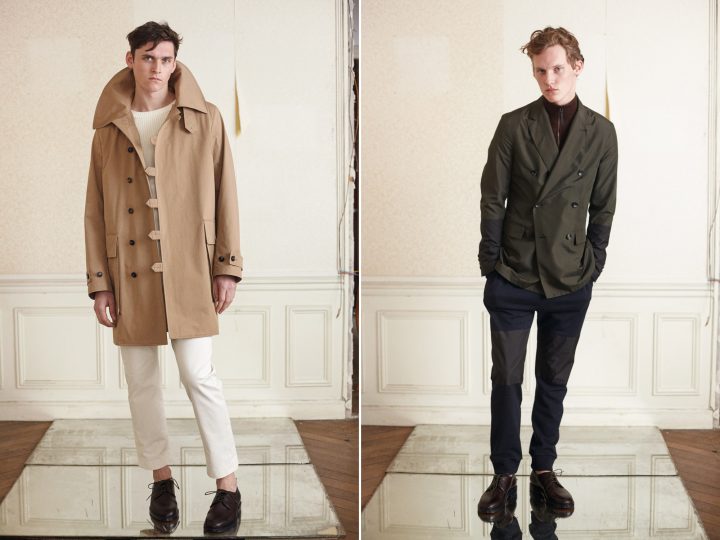
At the beginning of this year, the seasoned —yet low profile— Dutch fashion designer Paul Helbers reintroduced (after having designed under his own label Inch for a couple of years in the Nineties) himself to the world with the presentation of his ambitious eponymous new label in Paris. Having cut his teeth in different positions throughout the fashion industry after his graduation from the Royal College of Art, a former studio director of Maison Martin Margiela and 2006 until 2011 menswear designer at Louis Vuitton under Marc Jacobs, Helbers seems more than ready for his second coming. Last month, the designer presented his second collection for Spring/Summer 2017, but we still want to take another look at his inaugural set of creations, which granted the designer serious critical acclaim and forms a very inspirational start for any menswear label. The breakout collection will find its way to different retailers, among which are Mr. Porter and Barney's New York, in the coming month.
Inspired by the poetic images of Robert Rauschenberg, iconic horrorfilm actor Bela Lugosi and early Irving Penn portraits of Bernstein and TS Elliot, each celebrating an immaculate sense of dressing and off-duty style, with his label Helbers aims to fuel the strength of artisan skills with more abstract and contemporary ideas like the popular athleisure movement of recent years. In that sense the work of Helbers reminds us of another Dutch designer combining traditional tailoring with sportswear elements: Sebastiaan Pieter. To ensure the high quality standards set by Helbers, everything under the label is developed and produced at established ateliers around Venice in Italy. For Autumn/Winter 2016 this resulted in an sublime collection, consisting of wool cashmere joggers with matte nylon knee patches, lightweight semi-canvassed blazers in wool, silk and linen tweed, cashmere flannel cardigan jackets and some stand out waterproof unconstructed coats, which seamlessly seem to marry the aesthetic of former employers Margiela and Vuitton into the new entity of Helbers.
Each piece of the collection contains a hybrid quality and a feeling of unpolished elegance underlined by the subtle clash of contrasting fabrics, celebrating the rough and the refined. Ideas are carried out with a carefully chosen fusion of low-end and high-end materials always applying a rigorous manufacturing standard. The absence of ostentatious elements is a deliberate choice in order to formulate an un-precious sense of appearance. [ Continue reading ]